1487. Cinema Seat Allocation
Medium
Array
Hash Table
Greedy
Bit Manipulation
Description

A cinema has n rows of seats, numbered from 1 to n. Each row has 10 seats, numbered from 1 to 10.
You are given a 2D integer array reservedSeats, where reservedSeats[i] = [rowi, seati] means that seat seati in row rowi is already reserved.
A four-person group must be assigned to four seats in the same row. The group can be seated in one of the following seat blocks:
- seats
2, 3, 4, 5 - seats
4, 5, 6, 7 - seats
6, 7, 8, 9
A block can be used only if none of its seats are reserved. Each seat can be assigned to at most one group.
Return an integer denoting the maximum number of four-person groups that can be assigned.
Example 1:
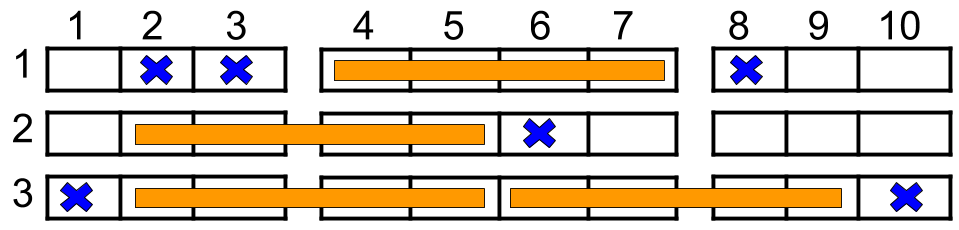
Input: n = 3, reservedSeats = [[1,2],[1,3],[1,8],[2,6],[3,1],[3,10]]
Output: 4
Explanation: The figure above shows an optimal allocation of four groups. Seats marked in blue are already reserved, and each set of four contiguous seats marked in orange is assigned to one group.
Example 2:
Input: n = 2, reservedSeats = [[2,1],[1,8],[2,6]]
Output: 2
Example 3:
Input: n = 4, reservedSeats = [[4,3],[1,4],[4,6],[1,7]]
Output: 4
Constraints:
1 <= n <= 1091 <= reservedSeats.length <= min(10 * n, 104)reservedSeats[i] == [rowi, seati]1 <= rowi <= n1 <= seati <= 10- All
reservedSeats[i]are distinct.
Hints
Hint 1
Note you can allocate at most two four-person groups in one row.
Hint 2
Greedily check if you can allocate seats for two groups, one group or none.
Hint 3
Process only rows that appear in the input, for other rows you can always allocate seats for two groups.
Similar Questions
Statistics
Acceptance
57.0%
Submissions
308,691
Accepted
175,856