2375. Minimum Obstacle Removal to Reach Corner
Hard
Array
Breadth-First Search
Graph Theory
Heap (Priority Queue)
Matrix
Shortest Path
0-1 BFS
Dijkstra's Algorithm
Description
You are given a 0-indexed 2D integer array grid of size m x n. Each cell has one of two values:
0represents an empty cell,1represents an obstacle that may be removed.
You can move up, down, left, or right from and to an empty cell.
Return the minimum number of obstacles to remove so you can move from the upper left corner (0, 0) to the lower right corner (m - 1, n - 1).
Example 1:
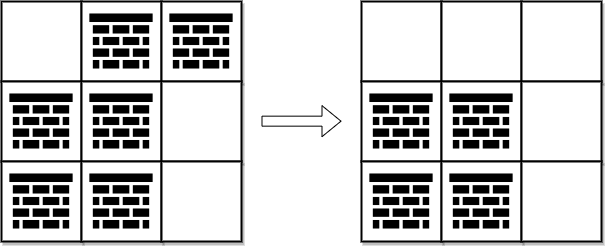
Input: grid = [[0,1,1],[1,1,0],[1,1,0]]
Output: 2
Explanation: We can remove the obstacles at (0, 1) and (0, 2) to create a path from (0, 0) to (2, 2).
It can be shown that we need to remove at least 2 obstacles, so we return 2.
Note that there may be other ways to remove 2 obstacles to create a path.
Example 2:
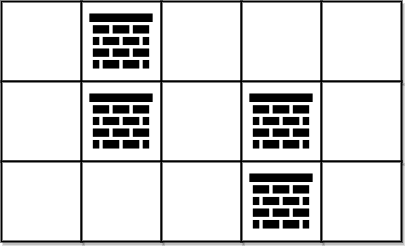
Input: grid = [[0,1,0,0,0],[0,1,0,1,0],[0,0,0,1,0]]
Output: 0
Explanation: We can move from (0, 0) to (2, 4) without removing any obstacles, so we return 0.
Constraints:
m == grid.lengthn == grid[i].length1 <= m, n <= 1052 <= m * n <= 105grid[i][j]is either0or1.grid[0][0] == grid[m - 1][n - 1] == 0
Hints
Hint 1
Model the grid as a graph where cells are nodes and edges are between adjacent cells. Edges to cells with obstacles have a cost of 1 and all other edges have a cost of 0.
Hint 2
Could you use 0-1 Breadth-First Search or Dijkstra’s algorithm?
Similar Questions
Statistics
Acceptance
71.1%
Submissions
184,404
Accepted
131,169