3691. Minimum Operations to Make Columns Strictly Increasing
Easy
Array
Greedy
Matrix
Description
You are given a m x n matrix grid consisting of non-negative integers.
In one operation, you can increment the value of any grid[i][j] by 1.
Return the minimum number of operations needed to make all columns of grid strictly increasing.
Example 1:
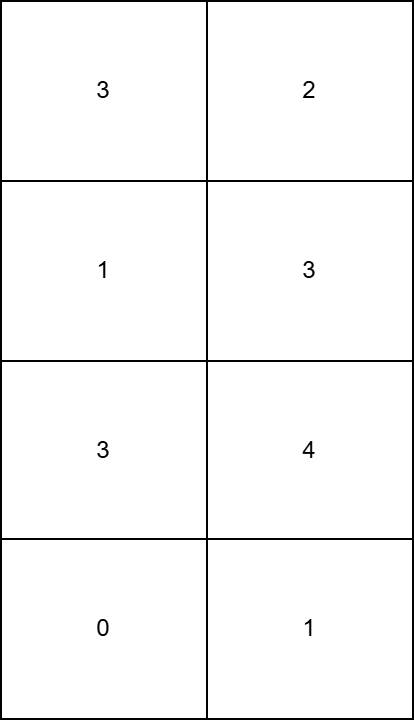
Input: grid = [[3,2],[1,3],[3,4],[0,1]]
Output: 15
Explanation:
- To make the
0thcolumn strictly increasing, we can apply 3 operations ongrid[1][0], 2 operations ongrid[2][0], and 6 operations ongrid[3][0]. - To make the
1stcolumn strictly increasing, we can apply 4 operations ongrid[3][1].
Example 2:
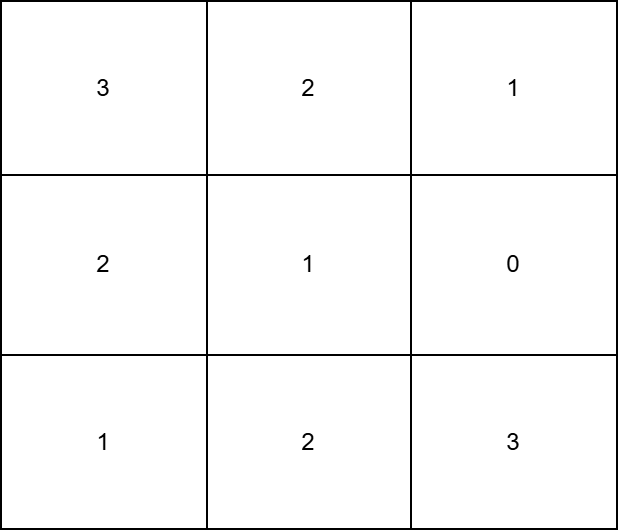
Input: grid = [[3,2,1],[2,1,0],[1,2,3]]
Output: 12
Explanation:
- To make the
0thcolumn strictly increasing, we can apply 2 operations ongrid[1][0], and 4 operations ongrid[2][0]. - To make the
1stcolumn strictly increasing, we can apply 2 operations ongrid[1][1], and 2 operations ongrid[2][1]. - To make the
2ndcolumn strictly increasing, we can apply 2 operations ongrid[1][2].
Constraints:
m == grid.lengthn == grid[i].length1 <= m, n <= 500 <= grid[i][j] < 2500
Hints
Hint 1
<code>grid[i + 1][j]</code> must be at least equal to <code>grid[i][j] + 1<code>.
Hint 2
Iterate on <code>i</code> in increasing order, and set <code>grid[i + 1][j] = max(grid[i][j]+1, grid[i + 1][j])<code>.
Similar Questions
Statistics
Acceptance
72.0%
Submissions
55,442
Accepted
39,906