1947. Number of Different Subsequences GCDs
Hard
Array
Math
Counting
Number Theory
Euclidean Algorithm
Greatest Common Divisor
Description
You are given an array nums that consists of positive integers.
The GCD of a sequence of numbers is defined as the greatest integer that divides all the numbers in the sequence evenly.
- For example, the GCD of the sequence
[4,6,16]is2.
A subsequence of an array is a sequence that can be formed by removing some elements (possibly none) of the array.
- For example,
[2,5,10]is a subsequence of[1,2,1,2,4,1,5,10].
Return the number of different GCDs among all non-empty subsequences of nums.
Example 1:
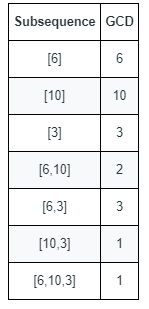
Input: nums = [6,10,3]
Output: 5
Explanation: The figure shows all the non-empty subsequences and their GCDs.
The different GCDs are 6, 10, 3, 2, and 1.
Example 2:
Input: nums = [5,15,40,5,6]
Output: 7
Constraints:
1 <= nums.length <= 1051 <= nums[i] <= 2 * 105
Hints
Hint 1
Think of how to check if a number x is a gcd of a subsequence.
Hint 2
If there is such subsequence, then all of it will be divisible by x. Moreover, if you divide each number in the subsequence by x , then the gcd of the resulting numbers will be 1.
Hint 3
Adding a number to a subsequence cannot increase its gcd. So, if there is a valid subsequence for x , then the subsequence that contains all multiples of x is a valid one too.
Hint 4
Iterate on all possiblex from 1 to 10^5, and check if there is a valid subsequence for x.
Similar Questions
Statistics
Acceptance
47.2%
Submissions
31,554
Accepted
14,905