2409. Number of Increasing Paths in a Grid
Hard
Array
Dynamic Programming
Depth-First Search
Breadth-First Search
Graph Theory
Topological Sort
Memoization
Matrix
Description
You are given an m x n integer matrix grid, where you can move from a cell to any adjacent cell in all 4 directions.
Return the number of strictly increasing paths in the grid such that you can start from any cell and end at any cell. Since the answer may be very large, return it modulo 109 + 7.
Two paths are considered different if they do not have exactly the same sequence of visited cells.
Example 1:
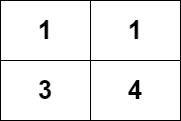
Input: grid = [[1,1],[3,4]]
Output: 8
Explanation: The strictly increasing paths are:
- Paths with length 1: [1], [1], [3], [4].
- Paths with length 2: [1 -> 3], [1 -> 4], [3 -> 4].
- Paths with length 3: [1 -> 3 -> 4].
The total number of paths is 4 + 3 + 1 = 8.
Example 2:
Input: grid = [[1],[2]]
Output: 3
Explanation: The strictly increasing paths are:
- Paths with length 1: [1], [2].
- Paths with length 2: [1 -> 2].
The total number of paths is 2 + 1 = 3.
Constraints:
m == grid.lengthn == grid[i].length1 <= m, n <= 10001 <= m * n <= 1051 <= grid[i][j] <= 105
Hints
Hint 1
How can you calculate the number of increasing paths that start from a cell (i, j)? Think about dynamic programming.
Hint 2
Define f(i, j) as the number of increasing paths starting from cell (i, j). Try to find how f(i, j) is related to each of f(i, j+1), f(i, j-1), f(i+1, j) and f(i-1, j).
Similar Questions
Statistics
Acceptance
57.2%
Submissions
151,713
Accepted
86,845